The fundamental theorem of arithmetic states that every integer greater than 1 can be uniquely represented as a product of one or more primes. While unique, several arrangements of the prime factors may be possible. For example:
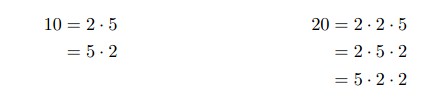
Let f (k) be the number of different arrangements of the prime factors of k. So f (10) = 2 and f (20) = 3. Given a positive number n, there always exists at least one number k such that f (k) = n. We want to know the smallest such k.